Your GE refrigerator still has power. The interior lights work and the display may look normal, but both the refrigerator and freezer sections are getting warm.
Does this mean the compressor has failed or the refrigerator needs to be replaced?
Not necessarily.
On many GE refrigerators, the problem may be related to the main control board. Another possibility is the compressor start relay, which helps the compressor begin running.
Both problems are normally repairable, but proper testing is important. Replacing an expensive control board without checking the compressor, relay, fans, wiring, and power supply can lead to an incorrect diagnosis.
The Issue: Both Refrigerator Sections Are Warm
Common symptoms include:
- The refrigerator section is not cold.
- The freezer is no longer freezing.
- Both compartments become warm at approximately the same time.
- The lights and control display still work.
- The fans may run, but the compressor remains silent.
- The refrigerator clicks repeatedly from the back.
- The compressor hums and then shuts off.
- The refrigerator stops cooling intermittently.
- Unplugging the refrigerator temporarily restores cooling.
- The refrigerator displays an error or temperature warning.
When both sections are warm, the problem is usually related to a component affecting the entire cooling system.
On many GE refrigerators, the freezer produces the cold air used by both compartments. Cold air moves from the freezer into the refrigerator section through a fan and air damper. If the compressor or shared cooling system stops operating, both sections eventually become warm.
How to Diagnose a GE Refrigerator That Is Not Cooling
Check the power and control settings
Open the refrigerator and confirm that the interior light works.
If there is no light or display, check:
- The wall outlet
- Refrigerator plug
- Circuit breaker
- Power cord
If the lights work, confirm that the cooling system has not been switched off accidentally.
Some GE refrigerators can display OFF when cooling has been disabled. Others may enter Demo Mode, allowing the lights and controls to work while the compressor and cooling system remain off. GE identifies Demo Mode as one possible reason a powered refrigerator may not cool.
Check the actual temperatures
Place appliance thermometers inside both compartments.
Normal target temperatures are generally:
- Refrigerator: approximately 37°F or 3°C
- Freezer: approximately 0°F or –18°C
If both temperatures are rising, move perishable food to another refrigerator or insulated cooler.
Do not rely only on the temperature shown on the display. The display may show the selected temperature instead of the actual internal temperature.
Listen for the compressor
The compressor is normally located behind the lower rear panel.
Listen for several minutes.
Possible observations include:
The compressor is silent: The main board may not be sending power, the start relay may have failed, or the compressor may be electrically open.
The compressor clicks repeatedly: The start relay may be attempting to start the compressor. However, clicking can also be caused by an overheating or internally damaged compressor.
The compressor hums and shuts off: The relay, overload protector, compressor, voltage supply, or wiring may be faulty.
The compressor runs continuously but the refrigerator remains warm: The problem may involve the sealed refrigeration system, refrigerant charge, compressor efficiency, condenser airflow, or evaporator airflow.
GE notes that clicking noises can involve the condenser fan, compressor, or control board, so the noise alone does not confirm which part has failed.
Check the fans
Many GE refrigerators have:
- A condenser fan near the compressor
- An evaporator fan inside the freezer
- Additional compartment fans on some models
If the compressor runs but the condenser fan does not, the compressor can overheat and cooling performance may decrease.
If the freezer evaporator fan does not run, cold air may not circulate correctly through either compartment.
A fan problem can sometimes look like a control-board failure because the main board controls fan operation on many electronic GE refrigerators.
Check for heavy frost
Look at the inside rear wall of the freezer.
A thick layer of frost or snow may indicate a defrost-system problem. The evaporator coil can become covered in ice, preventing air from moving through the refrigerator.
Possible defrost-related causes include:
- Defrost heater
- Defrost thermostat
- Temperature sensor
- Main control board
- Damaged wiring
The main board manages cooling and defrost functions on many GE refrigerator models. GE describes its electronic refrigerator boards as controlling functions such as cooling and defrost timing.
The Likely Solution
If the main control board has failed
The main control board receives temperature information from sensors and controls components such as:
- Compressor
- Condenser fan
- Evaporator fan
- Defrost system
- Dampers
- Other cooling functions
A failed relay or damaged circuit on the board may prevent the compressor or fans from operating.
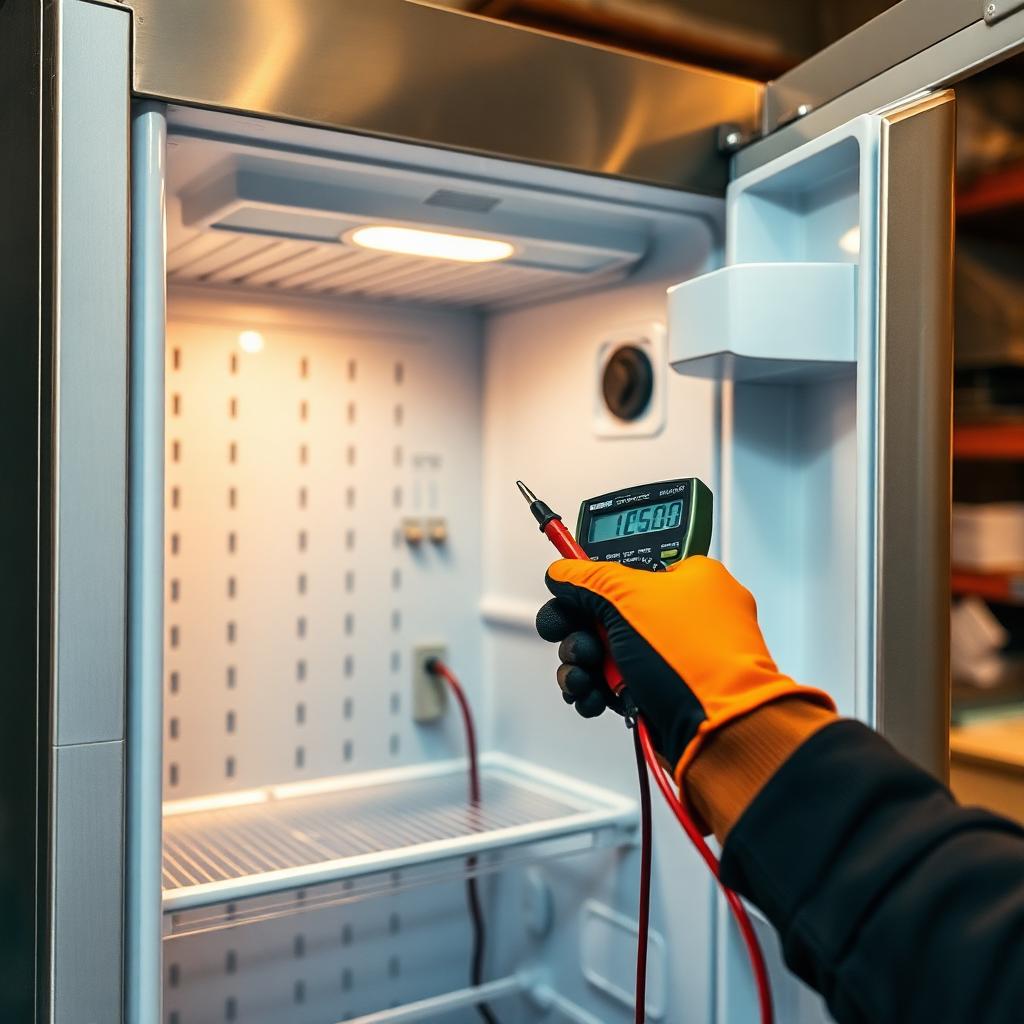
Before replacing the board, a technician should test:
- Power entering the refrigerator
- Voltage supplied to the board
- Compressor output from the board
- Fan outputs
- Temperature sensors
- Wiring harnesses
- Compressor start components
If the board receives the correct power but does not send the required voltage to a working component, board replacement may be recommended.
If the compressor start relay has failed
The compressor start relay helps the compressor start.
A failed relay may cause:
- Repeated clicking
- A humming compressor
- Compressor overheating
- Compressor starting intermittently
- Both compartments becoming warm
The technician should inspect and test the relay, overload protector, compressor windings, and wiring.
GE sells model-specific compressor start relays, but compatibility must be confirmed using the complete refrigerator model number.
Replacing the relay will not solve the problem if the compressor itself is seized or electrically damaged.
Technician’s Recommendation: Repair or Replace?
As an appliance technician, I normally recommend repairing a GE refrigerator when the problem is confirmed as the main control board or compressor start relay.
These are replaceable components. Their failure does not automatically mean the sealed refrigeration system or entire refrigerator is finished.
Most customers approve a start-relay repair because it is normally much less expensive than replacing the refrigerator.
Many customers also approve a main-board repair when the refrigerator is otherwise in good condition. A new refrigerator may cost two or three times more after including:
- Delivery
- Installation
- Removal of the old appliance
- Water-line connection
- Possible cabinet or doorway adjustments
The decision becomes more difficult when the refrigerator has several problems or the compressor is also damaged.
Repair is usually recommended when:
- The refrigerator is otherwise in good condition.
- The compressor tests correctly.
- The board or relay is the confirmed failure.
- Replacement parts are available.
- There is no major sealed-system problem.
GE Refrigerator Repair Prices
The final price depends on the model, part number, accessibility, and diagnosis.
Compressor start-relay repair
- Start relay and overload components: approximately $80–$220
- Professional labour: approximately $220–$280
- Estimated repair total: approximately $300–$500
Main control-board repair
- GE main control board: approximately $300–$650
- Professional labour: approximately $220–$280
- Estimated repair total: approximately $520–$930
These are general Canadian estimates before taxes, travel charges, or additional repairs.
GE uses many different control boards and start devices. Even refrigerators that look similar may require different parts. Always provide the complete model number before ordering.
Book a GE Refrigerator Repair
If both sections of your GE refrigerator are warm, first check the power, temperature controls, Demo Mode, fans, and frost buildup.
If you hear repeated clicking or the compressor is not starting, the start relay may be defective. If the compressor and fans are not receiving the correct power, the main control board may be responsible.
TrustedFix Appliance Repair can test the main board, start relay, compressor, fans, sensors, wiring, and defrost system before recommending a repair.
In many cases, replacing a confirmed relay or control board costs much less than purchasing and installing a new refrigerator.
Related service
Need a technician?
We handle appliance repair across Metro Vancouver and the Lower Mainland. Same-day service usually available.