The correct brand spelling is JennAir. This article explains the difference between an evaporator-fan problem and a failed defrost heater.
JennAir Refrigerator Not Cooling? Evaporator Fan or Defrost Heater Diagnosis
Your JennAir refrigerator has power, the lights are working, and you may hear the compressor—but the refrigerator is no longer cold.
Sometimes the freezer remains cold while the fresh-food section becomes warm. In other cases, frost builds up inside the freezer and eventually both sections stop cooling properly.
Does this mean the refrigerator needs to be replaced?
Usually, no.
Based on our appliance-repair experience, two components that should be inspected are the evaporator fan and the defrost heating element.
The evaporator fan circulates cold air through the appliance. The defrost heater melts frost from the evaporator coil. If either component fails, cold air may not circulate properly.
Step 1: Identify the Cooling Problem
Common symptoms include:
- The freezer is cold, but the refrigerator is warm.
- Both sections gradually become warmer.
- The refrigerator runs for long periods.
- Little or no air comes from the refrigerator vents.
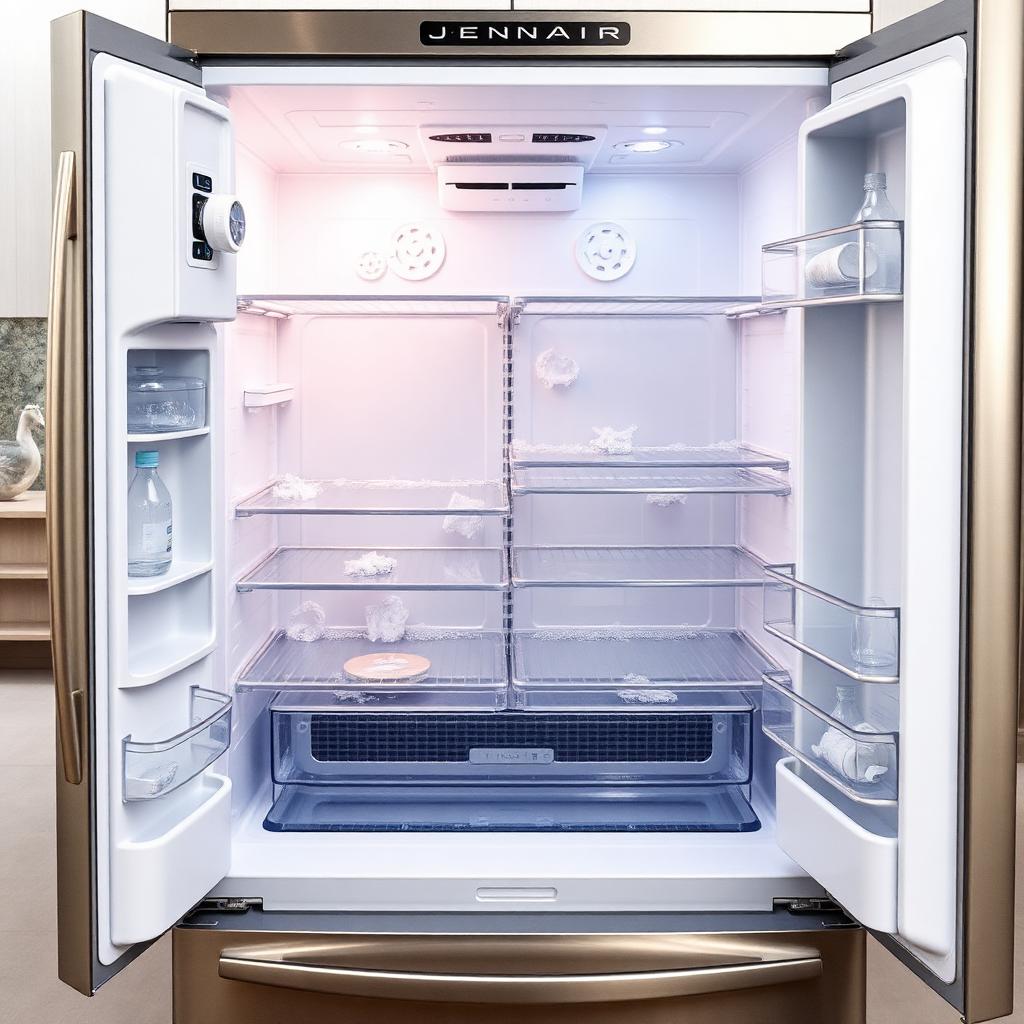
- The freezer’s rear interior panel is covered in frost.
- The fan makes a squeaking, grinding or rattling noise.
- The fan starts and stops randomly.
- Cooling improves temporarily after the refrigerator is unplugged and defrosted.
- Food near the bottom of the freezer remains frozen while the upper section becomes warm.
Most JennAir refrigerator designs generate cold air in or around the freezer and circulate it through vents into the fresh-food section. Blocked airflow can therefore make the refrigerator section warm even when the freezer still appears cold.
Signs of an evaporator-fan problem
The evaporator fan may be responsible when:
- The freezer is cold, but the refrigerator is warm.
- You cannot feel air coming from the vents.
- The fan is noisy.
- The fan works intermittently.
- The fan stops when it becomes hot.
- The refrigerator temperature changes throughout the day.
Signs of a defrost-heater problem
The defrost heater may be responsible when:
- Heavy frost covers the freezer’s rear panel.
- Ice repeatedly returns after being removed.
- Both sections slowly become warm.
- The refrigerator works again after being manually defrosted.
- The fan can be heard, but airflow remains weak because the evaporator is covered in ice.
A light amount of temporary frost can be normal, but a thick, persistent layer of frost is not. JennAir explains that normal frost should be light and should clear during the automatic defrost cycle.
Step 2: Check the Refrigerator Safely
Confirm the temperature settings
Make sure the refrigerator and freezer are switched on and are not in Showroom or Demo Mode.
In Demo Mode, the lights and controls may operate while the cooling system remains off.
Normal target temperatures are generally approximately:
- Fresh-food section: 37°F or 3°C
- Freezer: 0°F or –18°C
JennAir recommends approximately 37°F for the refrigerator, within a food-safe range of 32°F to 40°F.
Check the vents and food placement
Look for food packages blocking the air vents between the refrigerator and freezer sections.
Leave space around the vents and avoid packing food tightly against the rear interior wall. JennAir notes that blocked supply or return vents can interfere with airflow and cause poor cooling or frost accumulation. (Product Help | JennAir < )
Inspect the door seals
Look for:
- Tears or cracks
- Food preventing the door from closing
- A gasket pulled out of position
- A freezer drawer that is not fully closed
- Frost near one corner of the door
Warm, humid air entering through a poor seal can create excessive frost and add stress to the defrost system. JennAir recommends checking that the doors seal properly and that nothing is obstructing the gaskets.
Listen for the evaporator fan
The evaporator fan is usually located behind an interior freezer panel.
Open the freezer and listen for airflow. On many models, the fan stops when the door opens, so you may need to press and hold the door switch briefly.
Listen for:
- Squeaking
- Grinding
- Rattling
- A fan trying to start
- No fan sound
Do not remove interior panels while the refrigerator is connected to power.
Look for heavy frost
Inspect the freezer’s rear interior wall.
A thick sheet of frost or snow may indicate that the evaporator coil is frozen. Possible causes include:
- Failed defrost heater
- Defrost sensor or thermostat
- Thermal fuse
- Main control board
- Damaged wiring
- Door-seal or airflow problem
Do not use a knife, screwdriver or sharp object to remove ice. Refrigerant tubing and wiring may be located directly behind the panel.
Step 3: Determine the Likely Solution
If the evaporator fan has failed
A technician should test:
- Fan motor
- Fan blade
- Door switch
- Wiring and connections
- Voltage supplied to the fan
- Frost obstructing the blade
- Main control-board output
If the motor is noisy, intermittent or receives power without running, the evaporator-fan motor normally requires replacement.
The technician should also inspect the fan blade. A cracked or loose blade can create noise and reduce airflow even when the motor still works.
If the defrost heater has failed
The technician must remove the evaporator cover, melt the ice safely and test the defrost system.
The heater should be checked for electrical continuity. The technician should also test the sensor, thermostat, thermal protection and control-board output.
If the heater is electrically open or visibly damaged, it should be replaced.
Replacing only the heating element will not solve the problem if the actual failure is a sensor, thermal fuse, wiring connection or control board.
Step 4: Technician’s Recommendation
As an appliance technician, I normally recommend repairing a JennAir refrigerator when the evaporator fan or defrost heater is the confirmed problem.
These are replaceable components. Their failure does not mean that the compressor or sealed refrigeration system is finished.
Most customers approve the repair because JennAir appliances can be expensive to replace. A new refrigerator may also require:
- Delivery
- Removal of the existing appliance
- Water-line reconnection
- Door or handle removal
- Cabinet adjustments
- Specialized built-in installation
A refrigerator that temporarily cools again after being completely defrosted often still requires repair. Manual defrosting may restore airflow, but the frost will normally return if the automatic defrost system remains defective.
An accurate diagnosis is important. Replacing the fan will not solve a frozen evaporator caused by a failed heater, and replacing the heater will not solve an airflow problem caused by a failed fan.
Step 5: JennAir Refrigerator Repair Prices
The final cost depends on the exact model, part availability, refrigerator design and accessibility.
Evaporator-fan repair
- Evaporator-fan motor or assembly: approximately $180–$300
- Professional diagnosis and labour: approximately $280–$340
- Estimated repair total: approximately $460–$640
Defrost-heater repair
- Defrost heating element: approximately $190–$250
- Professional diagnosis and labour: approximately $280–$340
- Estimated repair total: approximately $470–$590
These are general Canadian estimates before taxes, travel charges or additional parts.
The repair may cost more if the refrigerator also needs:
- Defrost sensor or thermostat
- Thermal fuse
- Wiring repair
- Control board
- Door gasket
- Additional labour to remove a built-in appliance
JennAir refrigerators use different fans, heaters and defrost systems. The complete model and serial number must be checked before ordering parts. JennAir provides model-specific manuals and service information through its product-support system.
Book a JennAir Refrigerator Repair
If your JennAir freezer remains cold but the refrigerator is warm, check the vents and listen for the evaporator fan.
If heavy frost covers the freezer’s rear panel and cooling improves temporarily after defrosting, the defrost heater or another defrost-system component may have failed.
TrustedFix Appliance Repair can test the evaporator fan, defrost heater, sensors, door switch, wiring, airflow and main control board before recommending a repair.
In most cases, replacing a confirmed failed fan or heating element is much less expensive than purchasing and installing a new JennAir refrigerator.
Related service
Need a technician?
We handle appliance repair across Metro Vancouver and the Lower Mainland. Same-day service usually available.