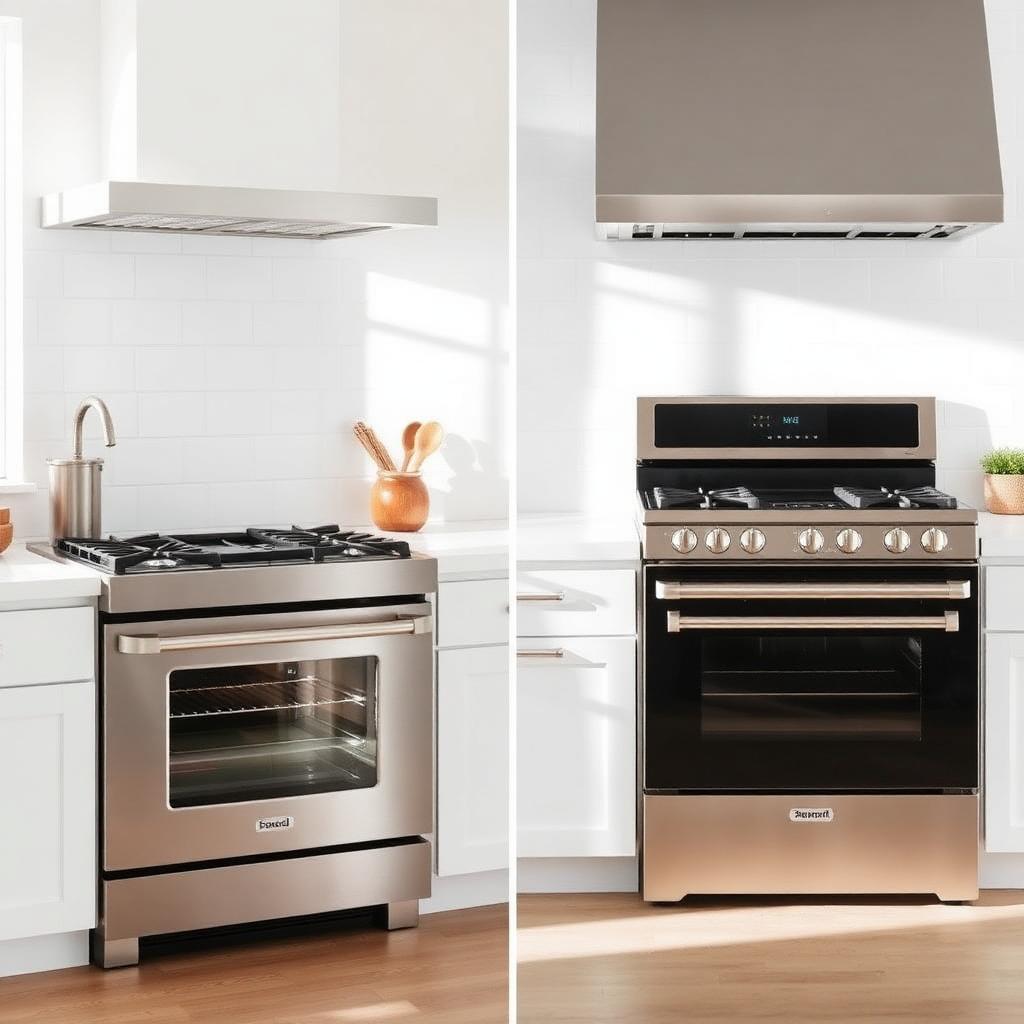
If you're shopping for a new stove, you'll see two main styles in every showroom: freestanding and slide-in. They look almost the same from a few steps back, but they install differently, cost different amounts, and give the kitchen a very different finished look.
This guide breaks down the practical differences so you can pick the right one for your kitchen — and avoid surprises on installation day.
What Is a Freestanding Range?
A freestanding range is the standard stove most homes already have. It has finished sides, so it can go anywhere — between cabinets, at the end of a run, or standing on its own in a rental. The controls sit on a tall back panel (called a backguard) that rises above the cooktop.
- Finished on all sides — can stand alone.
- Controls on a rear backguard.
- Widest selection of models and prices.
- Easiest to replace like-for-like.
What Is a Slide-In Range?
A slide-in range is designed to sit flush between two cabinets. There is no rear backguard — the controls are on the front, and the cooktop has small side lips that overhang the counter on either side. The result is a built-in, custom look with the backsplash fully visible behind the stove.
- Front-mounted controls.
- No back panel — the backsplash shows through.
- Cooktop lips seal the gap between stove and counter.
- Unfinished sides — must sit between cabinets.
Installation: The Biggest Practical Difference
Freestanding ranges are almost plug-and-play. Slide out the old one, slide the new one in, level it, done. They work in a standard 30-inch opening with no cabinet work.
Slide-in ranges need the opening to be exactly right. The side lips have to overlap the countertop, so the counter must be cut and finished cleanly on both sides. If you're switching from a freestanding stove to a slide-in for the first time, budget for a small counter modification — the old countertop cutout is usually not the correct shape.
Both types come in electric, induction and gas versions. Gas installations in British Columbia must be done by a licensed gas fitter, regardless of the range style.
Cost
Freestanding ranges start lower and top out lower. You can find a solid freestanding electric range for well under $1,000, and a high-end model around $2,500.
Slide-in ranges start higher — typically $1,500 and up — and premium models can exceed $4,000. You are paying for the built-in look, front controls, and often a more premium fit and finish.
Also factor in installation. A slide-in swap on a kitchen that was built for a freestanding range may add several hundred dollars in counter or cabinet work.
Design and Kitchen Look
If you love your backsplash — tile, stone, or a bold pattern — a slide-in shows it off. There's no backguard hiding the middle section. Slide-ins photograph well and are the default in newer custom kitchens.
Freestanding ranges hide the wall behind the stove with the backguard. That is actually useful in a rental or an older kitchen where the drywall behind the stove is unfinished or damaged.
Cleaning
Slide-ins win here. Because the cooktop lips overhang the counter, food and liquid can't fall into the gap between the stove and cabinets. Freestanding stoves always leave a small gap on each side that collects crumbs and grease.
Front controls on a slide-in are easier to reach but also easier for kids to bump. Most modern models include a control lock to prevent this.
Which Should You Buy?
Pick a freestanding range if:
- You're replacing an existing freestanding stove and don't want to modify cabinets.
- You want the widest choice at the lowest price.
- The stove will sit at the end of a run, or in a rental unit.
- The wall behind the stove is unfinished.
Pick a slide-in range if:
- You want a built-in, custom kitchen look.
- You've invested in a backsplash you want to see.
- The stove will sit between two cabinets or an island run.
- You're renovating and the counter is being cut anyway.
What About Repairs?
Both styles use the same core parts — bake and broil elements, igniters, control boards, cooktop burners or induction coils. Repair costs are very similar. The main difference is access: slide-ins are usually pulled forward the same way as freestanding units, but the front control panel takes a few more steps to service.
If your existing range is acting up — uneven heating, an oven that won't hold temperature, a burner that won't light — a repair is almost always cheaper than replacement, especially on units less than 10 years old.
Need Help With Your Range?
Our technicians repair and install both freestanding and slide-in ranges across Metro Vancouver and the Lower Mainland — electric and induction models from all major brands. If your current range needs service, or you're planning a slide-in swap and want to know what's involved, we can help.
Need a technician?
We handle appliance repair across Metro Vancouver and the Lower Mainland. Same-day service usually available.